
New York’s Updated Energy Codes: Key Changes for Residential and Commercial Projects
October 20, 2026New York’s updated 2025 Energy Conservation Construction Code of New York State took effect on December 31, 2025. Based on the 2024 International Energy Conservation Code (IECC), the updated code brings higher efficiency requirements and new considerations for how projects demonstrate compliance. Now that grace periods have passed, understanding the key changes and the available compliance pathways can help project teams make informed design decisions and avoid unnecessary cost and difficulty later in the process.
2025 New York Energy Code Changes
The updated New York energy code introduces significant changes for both residential and commercial projects. While some requirements build on previous code cycles, others introduce new efficiency measures, renewable energy requirements, and compliance considerations that can have a meaningful impact on design and construction. This article focuses specifically on New York State’s energy code. Projects in New York City must comply with the New York City Energy Conservation Code (NYCECC), which governs energy code compliance within that jurisdiction.
New York Residential Energy Code Changes
For residential buildings three stories or less, the updated code introduces changes to envelope performance, air and duct leakage testing, mechanical systems, and energy efficiency requirements. New York has also incorporated several state-specific provisions that affect how projects demonstrate compliance.
- Air leakage requirements and testing have changed. (R402.5.1.3) The updated code prescribes a 3 ACH limit for the prescriptive pathway, while allowing up to 4 ACH under the performance and ERI pathways. Multifamily projects with eight or more dwelling units can also use a sampling approach for air leakage testing, which can reduce the number of units that need to be tested.
| Compliance pathway | Previous code version | Updated maximum air leakage |
| Prescriptive | 5 ACH | 3 ACH |
| Performance/ERI | 5 ACH | 4 ACH |
- Duct leakage testing is now required across compliance pathways. (R403.3.4) All ducts must be located within conditioned space to reduce energy losses and improve HVAC efficiency. Duct leakage testing is required across compliance pathways, with a sampling option available for multifamily projects. Planning for testing early helps teams identify and address issues before they become more difficult and costly to correct.
- Mechanical ventilation and exhaust fans must meet new efficiency and testing requirements. (R403.6.2 & R403.6.3)The updated code establishes new efficiency requirements for mechanical ventilation and all outdoor air ventilation systems. It also introduces third-party testing and verification of these systems where required by the code official, along with new controls for intermittent bathroom exhaust fans.
- Compliance pathway selection matters. The updated code offers prescriptive and multiple performance-based pathways, and the differences between them can be significant. The compliance pathway can affect envelope design, HVAC systems, efficiency measures, testing requirements, and the role of energy modeling. Evaluating options early can help project teams identify the most practical path to compliance.
New York Commercial Energy Code Changes
From new renewable energy and efficiency requirements to more detailed testing and commissioning provisions, the latest commercial code updates can have a meaningful impact on project costs and flexibility. Understanding the requirements and evaluating compliance options early can help project teams make informed decisions and avoid costly changes later in the process.
- Renewables are now a major factor in NY energy code compliance. (C405.15.1) Even projects using a performance-based pathway may struggle to comply without incorporating renewable energy. The updated code establishes a baseline requirement of 0.75 W/sq. ft. of conditioned floor area for on-site renewables. Multifamily projects may benefit from energy modeling to optimize compliance and potentially avoid the need for additional off-site renewable energy purchases.
- ERVs are a prescriptive requirement for dwelling units but not mandatory. (C403.7.4.1) Under the prescriptive path (i.e., COMcheck) energy recovery ventilators (ERVs) are required for all dwelling units in buildings with four stories and above. Alternatively, energy modeling can be used to comply with an alternative performance pathway that does not require ERVs in dwelling units.
- Commissioning is more clearly defined and enforceable. (C408.2) Although commissioning was required under the last code update, more detailed compliance documentation and verification requirements are now in effect. The code now outlines the commissioning process as:
- Creation of a commissioning plan and verification that it was followed during construction
- Functional testing of HVAC equipment and controls, economizers, lighting controls, and service water heating systems, as applicable
- Completion of systems adjusting and balancing
- Completion of commissioning documentation, records, and training
- Preparation and submission of a preliminary commissioning report
- Owner or owner’s representative sign-off confirming commissioning compliance
Figure C408.2.4 – Commissioning Compliance Checklist 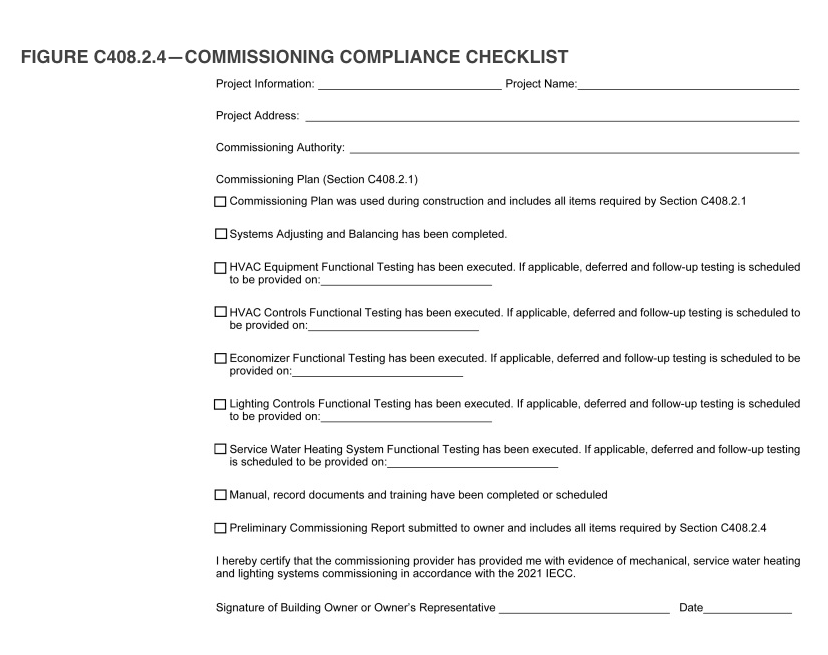
- Efficiency credits are now required. (C406.1.1) Projects using the prescriptive compliance pathway must select and implement required efficiency measures, while performance pathway projects must also account for these requirements in the baseline energy model.
- Compliance pathway selection is more critical than ever. The differences between prescriptive and performance pathway compliance, and even between the IECC and ASHRAE 90.1 versions of these pathways, are more significant under the updated code. Selecting the right pathway early can heavily influence design flexibility, required systems, construction costs, and overall project compliance.
Final Thoughts
New York’s updated energy codes bring new requirements and more decisions for residential and commercial project teams. With multiple compliance pathways and significant differences in their requirements and tradeoffs, the approach you choose can have a meaningful impact on design flexibility, project costs, and the overall difficulty of achieving compliance.
Engaging an experienced energy code consultant early can help you evaluate your options, optimize your compliance strategy, and identify opportunities to reduce project costs while minimizing compliance risk. ReVireo can help your project navigate New York’s updated energy codes and find the right path to compliance. Contact us to get started.